

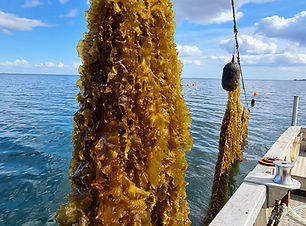
Seaweed
The brown algae sugar kelp (Saccharina latissima) is the seaweed species that gives the highest yield and is most developed for production on longlines. There are also other seaweed species that can be farmed such as the red algae dulce (Palmaria palmata) and sea lettuce (Ulva lactuca).
The mother plants for sugar kelp are collected locally in Kerteminde Bay as these kelp spores are adapted to local conditions and therefore give the best yield. Sugar kelp is perennial and therefore it is possible to harvest up to 3 years on the same plant which on average has a yield of approx. 5 kg. per year per meter of sown line. Kerteminde Seafarm has a capacity of 300 tons of kelp per year if the entire facility is utilized for the production of sugar kelp.

Mussels
The blue mussel is the most common mussel species in Denmark and has the Latin name Mytilus edulis, where edulis means edible. In Denmark, we do not have the same tradition of eating blue mussels as other countries in Europe, even though we have a large natural population and the largest production of organic mussels of the best quality. Therefore, most of the total production of blue mussels in Denmark is exported, primarily to the Netherlands, which sells them on to other countries - boiled or fresh.
It is possible to produce 15 kg of mussels per year per meter of growth line and if the entire capacity of the plant is utilized, it is possible to produce 500 tons per year.

Oyster
The native oyster species in Denmark is the flat oyster (Ostrea edulis). Flat oysters were previously very common on most coasts but are now only widespread in the Limfjord. It is possible to farm flat oysters in cage systems that can be used on the same longlines for seaweed and mussels. However, it is a difficult species to farm compared to the Pacific oyster (Gigas), as it has a slow growth rate and is sensitive to disease. Therefore, the production of flat oysters in Denmark is not yet at a commercially sustainable level and this requires research and development of spats (small oysters) that are resistant and suitable for farming. Therefore, the production of oysters in Kerteminde Seafarm is only based on trials and development of production systems.